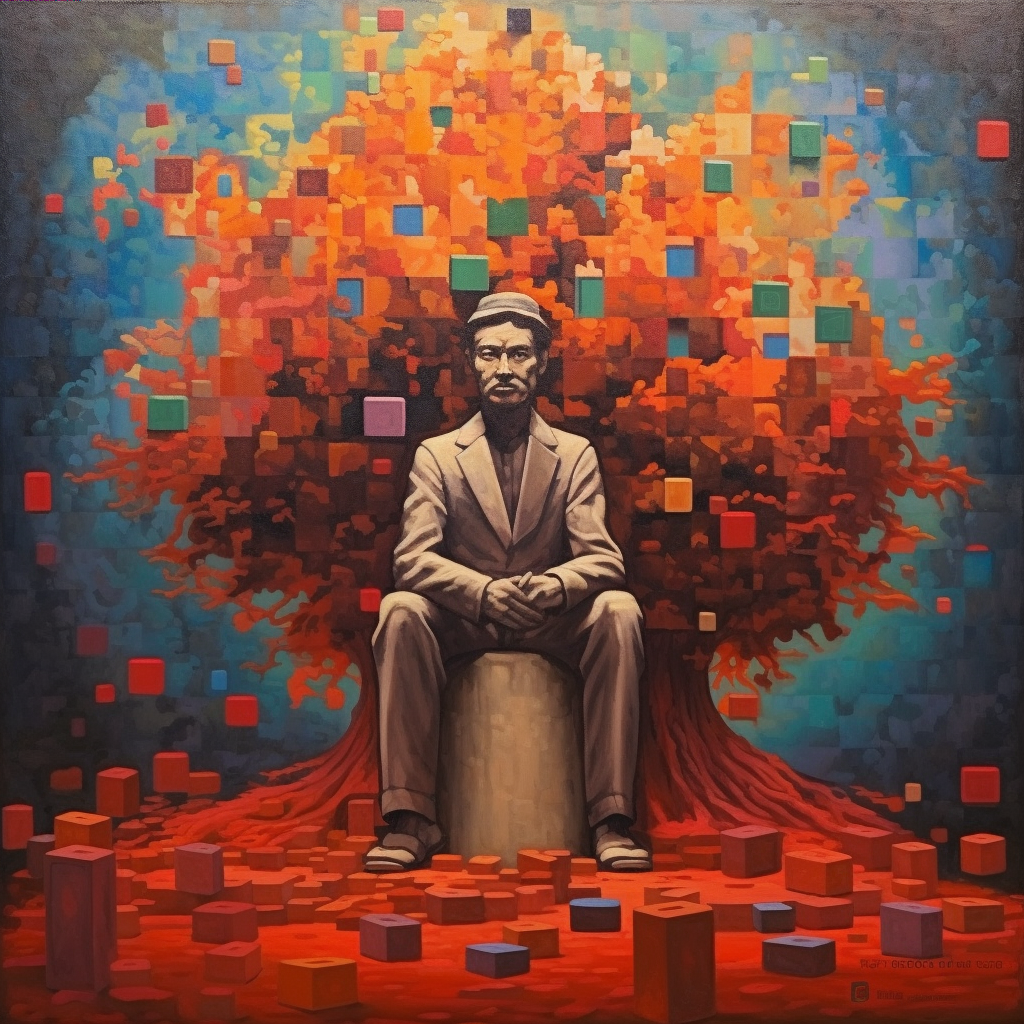
# bitmap 101

It takes advantage of the nature of data's unique ability to be parsed from multiple angels.

Welcome to Bitmap, a transmutational Metaverse standard tapping into the Bitcoin Blockchain. Leveraging the Ordinals theory and Bitmap theory, Bitmap offers a method to inscribe land claims unto consensual geospatial canvas real estate across the timechain tapestry known as Bitcoin. It's a new frontier in the world of decentralized digital ownership and a new understanding of Metaverse.

<figure><img src="/files/N8xJKbsnQpzr5owJKSg4" alt="" width="375"><figcaption><p>"Some inventions are more like discovery's" - <em>Bitoshi Blockamoto</em></p></figcaption></figure>

### What is Bitmap?

Bitmap is a consensus standard that allows anybody to claim the geospatial digital real estate of a Bitcoin Block. This process is achieved by being the first to inscribe *`{block-height}.bitmap`* unto a Satoshi using the Ordinals Inscription standard. This process is equitable and decentralized, transmuting any Bitcoin Block into a part of the Metaverse at the cost of energy.

Platforms can parse these inscriptions, and the related Bitcoin Block data, into the 3D realm and grant access to block owners, creating a new paradigm for open-source development.

Bitmap Theory represents the mapping of Bitcoins data landscape to spatial analogues, bringing to light the base substrate of a persistent Metaverse. To own a piece of the Bitcoin Map known as Bitmap, one must own a valid District or Parcel land inscription.


# bitmap theory whitepaper

A Persistent Natural Digital Meta-Terrain

<figure><img src="/files/q3EbiWJqS64jKcOTZEm8" alt=""><figcaption><p><em>Cover created by BitmapperGPT (alpha).</em></p></figcaption></figure>

**Summary.** A spatial digital realm derived from the data and ruleset of Bitcoin amounts to a universal persistent virtual landscape which inherits the unique properties of Bitcoin. It takes advantage of data's unique ability to be parsed from multiple angels. This paper introduces the core vital components of Bitmap Theory which enable on-chain reading and writing Bitmap data on Ordinals.

{% hint style="info" %}
Click through the links in **CONTENTS** to browse the Bitmap Theory living **whitepaper**.
{% endhint %}

## CONTENTS

{% content-ref url="/pages/i9cTw2hdKmVBjiJkq87s" %}
[Abstract](/bitmap-theory-whitepaper/abstract)
{% endcontent-ref %}

{% content-ref url="/pages/0LR1DeF4p29G5IRUkfq3" %}
[Introduction](/bitmap-theory-whitepaper/introduction)
{% endcontent-ref %}

{% content-ref url="/pages/8WEWwTwqpMdGfL1bbhSa" %}
[Background](/bitmap-theory-whitepaper/background)
{% endcontent-ref %}

{% content-ref url="/pages/Mhb6akBUSWPzYiQcfE48" %}
[Methodology](/bitmap-theory-whitepaper/methodology)
{% endcontent-ref %}

{% content-ref url="/pages/gwh3Axd4K4vdUuyr1WU4" %}
[Theory](/bitmap-theory-whitepaper/theory)
{% endcontent-ref %}


# Abstract

<figure><img src="/files/TTd3IqgEFUbvYN6vNHP4" alt=""><figcaption></figcaption></figure>

**Abstract.** A spatial digital realm derived from the data and ruleset of Bitcoin amounts to a universal persistent virtual landscape which inherits the unique properties of Bitcoin. It takes advantage of data's unique ability to be parsed from multiple angels. Bitcoin Blocks are the fundamental base layer of Bitcoin, serving as collections of transactions. Bitmap is a consensus ruleset based upon the simple theory that Bitcoin Blocks, Transactions, and the fundamental data structure of Bitcoin can be represented spatially. Anybody can claim space on this universal multi-dimensional canvas, underpinned by Ordinals Theory, opening the possibility to pin digital artefacts to co-ordinates. Bitmap acts as a pointer to block data, with a first-is-first expandatory supply tied to number of Bitcoin Blocks. Valid Bitmap holders are the key bearers. Bitmap inscriptions and builders may inscribe unto their Bitmap using this theory and standard. Bitmap has fast become adopted globally as a new social consensus layer atop Bitcoin. By its nature, it attracts a global effort to provide value to this realm. The results of the rollout of Bitmap point towards an ever-growing, evergreen vibrant developer economy for the ongoing future on the perma-web Metaverse on the most widely adopted Blockchain.


# Introduction

<figure><img src="/files/ntsKy5lTkeQE1nXau1eK" alt=""><figcaption><p>"Some inventions are more like discoveries" - <a href="https://twitter.com/blockamoto">Bitoshi Blockamoto</a></p></figcaption></figure>

Every ten minutes, on average, a new block of transaction data is born on the Bitcoin Blockchain. The data within this block represents the collective human and machine proof-of-work energy transferred between parties. Each block proves the work of the miners meeting the work of the users who transact in Bitcoin, capturing the energetic balance between human and machine. The data is generated by its cryptographic collaborative procedure, and spans the globe, forming a global collective memory of transactions.

The aim of Bitmap Theory is to map the dimensions of Bitcoin spatially, unveiling a unified Metaverse seed generated by its naturally high-permanence data structure. Typically procedural generation utilizes arbitrary data to create cohesive random worlds within a specified ruleset. In the example of Minecraft, the same seed will always result in the same world. However there is no singular world of Minecraft. Minecraft is a world generator.

Bitmap, on the other hand, proposes Bitcoin as the seed set of data which can be interpreted to generate a universal digital space. Due to the nature of Bitcoin, this would satisfy the true definition of Metaverse, which is typically defined as a theoretical persistent universe. The data underpinning this Bitmap universe lives on every single Full Bitcoin Node, maintained by the miners of Bitcoin who bring each block into existence like new stars being born.

The Theory enables reading and writing using the Bitmap standard, and across these interpretations we can form a base-level of truth, terraforming this map as a unified experience, regardless of platform. Whilst platforms may interpret the data in unique ways, the data itself is shared across all platforms. This allows all platforms to be referencing the same shared landscape when building. This creates a system whereby anything built with Bitmap Theory inherits the longevity of Bitcoin, and the robustness of Ordinals Theory.

This paper outlines the core theory & ruleset of Bitmap, and introduces new concepts proposed to satisfy both the reading and writing with Bitmap Theory at each level of resolution, and across all known dimensions of Bitcoin. Most notably, the ability to pin inscriptions to your Bitmap Districts and Parcels broadly, or to specific co-ordinates, will be proposed. This vital core component of Bitmap, which has been missing from the Standard up until this point, will enable the on-chain terraforming and building of the land. The ongoing provenance of changes made to the Bitmap landscape will be accessible through the ruleset defined in this paper, and maintained by Bitcoin.


# Background

Bitmap takes the data generated by the Bitcoin procedure as input, applies a ruleset, and outputs a Metaverse. That is the core procedure laid out in this paper, and so it is important to have a topographic view of the foundations that Bitmap is built upon. This section outlines these important pillars in detail so it may be further extrapolated with Bitmap Theory.

<figure><img src="/files/tASZR7W8CGSq8s80HRM5" alt=""><figcaption><p>Bitcoin and Ordinals Theory set the foundation for the Bitmap as a theory and ruleset for a universal Metaverse seed.</p></figcaption></figure>

## PROCEDURAL GENERATION

This term simply refers to the creation of data by computers. The process takes data input, feeds it through a procedure to generate the output. This is often used in video games as a method to generate unique worlds that follow a specific consistent ruleset. The procedure is generally designed to be repeatable, meaning the same input will always result in the same output, so to reach a different output requires a different input or procedure. Here is a breakdown:

**Input.** Generates arbitrary data through a pseudo-random process.

**Algorithm.** Applies a set of rules to the data.

**Output.** The data is expressed through the ruleset.

Due to the usefulness of arbitrary data in the generation of unique outputs, this is typically a procedure to generate pseudo-randomness and apply a ruleset has widespread use in video games and movies to create vast natural looking worlds worlds unique for each player, and is used as a tool across many other disciplines.

It is the act of transmuting data from an one state to another.

It could be argued that Bitcoin is a procedural data generation algorithm. Since the Bitcoin dataset is public, immutable, and unified by design, this allows for a new angle of procedural generation to be thoroughly explored, the **universal Bitcoin seed**.

## BITCOIN

Bitcoin is a peer-to-peer electronic cash system created by the pseudonymous Satoshi Nakamoto. Its core component is the Blockchain, which is a unified ledger of account registering Bitcoin token transaction in clusters known as blocks. These blocks form a compounding chain of cryptographic proofs. This chain of blocks, or blockchain, is secured by every full Bitcoin Node, and the miners who are incentivized by the rewards to dedicate their computer power to solving each block. This system allows for the transfer of Bitcoin tokens (BTC) by anybody with internet connection to any bitcoin address.

### ADDRESS

A Bitcoin address is made up of a public key, and a private key.

* Public Key. This key enables an address to receive bitcoin.
* Private Key. This key enables an address to send bitcoin.

Both keys enable the reading of the contents of the address.

### NODE

A Bitcoin node is a computer with software that synchronizes and validates transactions and blocks.

### MINER

A Bitcoin miner is a computer with software that solves cryptographic puzzles to confirm Blocks of Transactions in return for rewards known as Coinbase, and fees collected from transactions.

### WALLET

A wallet provides transfer services to users. Wallets are made up of addresses and seed phrases.

* Addresses. The wallet service works with your private keys.
* Seed phrases. A sequence of words cryptographically tied to all addresses generated from it.

### BITCOIN (BTC)

Bitcoin, or BTC, is the primary unit of account. There are eight decimal places for the Bitcoin token, as such: 1.00000000. There will never be more than 21 million BTC in existence.

### SATOSHI'S

A Satoshi is the smallest unit of measure of Bitcoin, equal to 0.00000001btc. Thus, 1btc equals 100000000 Satoshi's. There will never be more than 209999999999999 Satoshi's.

### UTXO

The Unspent Transaction Outputs (UTXO) are the actual chunks of Satoshi's which make up the balances of each address. These are typically measured in BTC value. They can be thought of like the coinage of Bitcoin, however unlike real world coins, UTXO's can be broken down to any size. They are brought into existence by successful miners as the reward for validating the block of transactions.

### TRANSACTIONS

A transaction transfers BTC from and to one or multiple addresses. Transactions are made up of Inputs and Outputs which come to meet the transfer value required.

**Inputs.** The transaction collects UTXO's from the input addresses to meet the value of the required output specified in the transaction.

**Outputs.** The inputs value comes to match the output value. If the input UTXO's equal more than the required outputs, an input UTXO is broken down into multiple output UTXO's, and the change is returned back to sender as an output.

**Coinbase (miners rewards).** These are special transactions as they represent new Bitcoin being brought into circulation. They are rewarded to the successful miner that validates the Bitcoin transaction.

*NOTE: NOT TO BE CONFUSED WITH THE COMPANY COINBASE*

**Mempool.** This houses transactions which have been broadcast and are awaiting to be accepted into a Block. This can be thought of as Bitcoin's short-term memory, each transaction broadcast is competing for the limited block space.

**Fees.** Each transaction has a fee attached to it measured in Satoshi's per vByte, which are rewarded to the successful miner in addition to the Coinbase reward.

**Transaction Hash.** This is the unique identifier for transactions generated once a transaction has been accepted into a Block.

### BLOCKS

A block is a collection of transactions broadcast by nodes, cryptographically compiled and confirmed by a miner and proliferated to all nodes. The first transaction in any Block is the coinbase miners reward for solving the cryptographic proof confirming the Block. Additional transactions in the block are between Bitcoin addresses competing for the 4mb maximum vBytes per block. This can be thought of as the long term memory of Bitcoin. Each further block cryptographically confirms each previous block immutably. Theoretical changes to past blocks would alter each subsequent hash. This means changes cannot be made to the ledger without immediately losing sync with the blockchain.

<figure><img src="/files/4lZvzRmY7nfkMWgNjROV" alt=""><figcaption><p>Structure of the Blockchain.</p></figcaption></figure>

#### BLOCK HEADER

The data within the block header validates the transactions within this block, and all previous blocks.

**Merkle Root.** When a Block is confirmed, the transactions are ordered and hashed in pairs. These pairs are hashed in pairs, and those pairs are hashed in pairs, until a final hash is reached. This hash is known as the Merkle Root at the top of the Merkle Tree.

**Nonce.** Each block has a number that occurs only once (NONCE). This is the random number that miners are seeking to find. It is the key to solving the merkle root which .

**Previous Block Hash.** Before the final Block Hash is reached, Previous Block Hash is applied to the Merkle Root & Nonce, forming the final Block Hash.

**Version.** This denotes which block version is being used, up to the current version 4.

**Time.** This is the time (in Unix Epoch Time) when the miner started hashing the header.

**Bits.** This is the target threshold that the block headers hash must be greater than.

**Block Header Hash.** This is the final unique identifier of a Block, also known as Block Hash.

#### BLOCK BODY

This section contains all the transaction data in the same order as the unravelled merkle tree.

### BLOCKCHAIN

Due to the design of the Blockchain, namely the inclusion of the Previous Block Hash, each block forms a link in a cryptographic chain. Each subsequent block confirmation validates each previous block as well as the current one. This means that previous blocks cannot be edited in any way without changing each subsequent block hash, which would put the node out of sync with the dominant network chain, which is the longest.

### DIFFICULTY ADJUSTMENTS

The time to solve a Block is variable, however a core mechanism of Bitcoin is the Difficulty Adjustment, which adjusts the difficulty of the cryptographic proofs every 2016 Blocks to be closer to the ten minute per block target. It is a self-balancing mechanism to make sure the hashrate does not become too fast or too slow.

### HALVING EPOCH

Every 210000 Blocks the coinbase miners reward, which brings new Bitcoin into existence, is halved. It started at 50btc. At Block 210000, this was halved to 25btc. This was then halved to 12.5btc, then 6.25btc, and so on. Due to this, the Bitcoin in circulation will never reach higher than 21000000btc.

## ORDINALS THEORY

Ordinals Theory is made up of two core modules, the Ordinals and the Inscriptions, which together enable universal indexation of immutable data upon the UTXO's against a specific Satoshi.

### THE ORDINALS

The ordinal indexation of Satoshi's (the smallest unit of Bitcoin) is known as the Ordinals. To make this possible, we check the moment new BTC is brought into supply at its source, the Block Coinbase Reward which can be measured in Satoshi's, indexed, and its journey subsequently followed through the breakdown of Block Rewards into smaller UTXO chunks.

**UTXO Tracking.** It is possible to trace the lineage of each UTXO back to its Coinbase. This is the basis of how to index Satoshi's ordinally.

**Satoshi Indexing.** Starting with Block 0 coinbase reward UTXO, which is a 50btc chunk, you index each Satoshi upon this UTXO. If you follow this process for each coinbase block reward, you can trace the breakdown of UTXO's through subsequent transactions maintaining a consistent record of ordinally counted Satoshi's from the birth of Bitcoin to the final Satoshi. Each Satoshi is given a unique hash and identity, which unlocks the inherent non-fungibility and identity of UTXO's and Satoshi's, and opens up the ability to index anything on-chain against your Satoshi's.

### THE INSCRIPTIONS

An inscription is the process of writing data in the UTXO where a specified ordinally indexed Satoshi lives. This creates a vast digital co-ordinates system for data indexation upon which address holders may write data upon their own UTXO's, indexed to a specific Satoshi.

### ADDED FEATURES

**Recursion.** This allows other inscriptions to be recursively called with the endpoint: */content/{inscription-id}/*

**Parent & Child.** This will allow a Parent inscription to create its own Child inscription, which is relationally tied to the Parent by splitting its UTXO into Parent & Child. This relationship, and all subsequent ones down the family tree can theoretically be identified and tracked.

### ORD EXPLORERS

The Ordinals Explorer, created by the ord team, is the primary resource to browse the Ordinals and Inscriptions. It allows a granular atomic view of Ordinals and the Inscriptions tied to them.


# Methodology

<figure><img src="/files/cmh0x5PfSucLz6L58DeB" alt=""><figcaption><p>The FOUR pillars of TRIP.</p></figcaption></figure>

In the journey from Theory to Product, four key pillars of Bitmap's development have been identified and codified to form a useful framework which can be leveraged to categorize and track efforts.

TRIP is an acronym that stands for *Theory*, *Ruleset*, *Index*, *Product*. Whilst the framework has been devised specifically as an aid for Bitmap, it may be useful as a tool to unify efforts across any discipline with the same core foundational TRIP elements required for their protocol or system to function. The scope of this paper is strictly Bitmap, and so this paper is an example of the application of TRIP as an organizational framework, and its further open development is encouraged.

The methodology forms the base structure of this whitepaper. Each pillar is introduced in this section, why they are vital, how they relate, and the dependencies between each layer.

### THEORY METHODOLOGY

Preceding any ruleset, theoretical underpinnings should be thoroughly developed. This is imperative, as there should be a core insight or basis for the ruleset to exist based on sound theory.

The Theory is the reason the ruleset matters, and it is intrinsically tied to ruleset. With this distinction made, the results of ruleset can be explored and evaluated against their theoretical basis.

The Theory section explores the key insights of Bitmap Theory and proposes a theoretical basis for a unified Metaverse built on Bitcoin. The core thesis behind Bitmap Theory is to consider the idea that Bitcoin, is an energetic transfer device now woven into the fabric of humanity, and introducing the practice of transmutation of data from one state to another, in this case, from Bitcoin to Metaverse.

### RULESET METHODOLOGY

The specific consensus rules which are to be followed by those in agreement with the consensus are to be laid out in a concrete and repeatable ruleset. The ruleset can be applied to the data by parsers of the data, usually through one of the available index providers. This approach allows for the composability of index and application layer.

It is the most decentralized approach, as anybody with access to a Bitcoin node can follow the same ruleset and reach the same result, in theory. The ability for this to be tracked through time is merely a matter of the strength of the ruleset applied to the data. In this case, the ruleset applies to the codification of the Bitcoin map graph, and the added layer of inscriptions and commands that may be recognized by all parties that wish to be a part of this ecosystem.

It can be thought of like a ruleset in a trading card game like Magic: the Gathering. rulesets must be resolvable. To ensure the robustness of the base layer of Bitmap, it is designed in a layered manner. The core layer is the District. This is the immovable object of Bitmap, adopted as the core premise of Bitmap. The next layer is Parcels. And so on. Each ruleset is a layer that can exist, or be used in conjunction with any other layer, or in isolation. These use-cases can be developed by anybody, as can new ruleset layers, and the strength of any new ruleset is often tested live against the market. For example, a ruleset such as the brc420 avatar standard exists in conjunction and interoperable with Bitmap. Any flaws in the ruleset or updates that cause what is essentially a new chain, will bear out in the indexing stage and have drastic impact on the ability to reach the same result from the same data. This is a major risk factor for new protocols, the unintentional forking of the provenance.

The TRIP methodology proposes that the **gold standard** for developing any new protocol ruleset is:

> ***RESOLVABLE AND REPEATABLE***

This is why the Ruleset from which the Product is ultimately founded upon must be transparent. If accomplished successfully, it means that all developers can work together with a unified ground truth. It is the lens through which the data is viewed through by all consensus participants.

### INDEX METHODOLOGY

For products to be built upon Bitmap, reliable ongoing access to the necessary data is key.

Not every Bitmap developer will be running a full node, so to be able to parse Bitcoin for the inscription and block data from which Bitmap is derived, the data must by served by a third party running a full node or otherwise serving the necessary data. To apply the Ruleset to the data on behalf of the platforms is the role of the index. To enable the ongoing independence of indexers, the ruleset must be resolvable & repeatable, transparent & public. This allows anybody who wishes to build their own index, and keeps all indexers accountable, preventing disparities between indexing efforts by using Bitcoin as the ruleset settlement layer. Anybody can prove whether an Indexer has gone outside of the consensus ruleset or data by testing the results of a ruleset themselves. Indexers carry this burden, and so the importance of accurate indexing cannot be understated, which reinforces the vital role of a resolvable, repeatable ruleset. Bitmap products cannot operate without accurate functional indexing.

### PRODUCT METHODOLOGY

Bitmap products utilize Bitcoin data served by indexers following rulesets based upon Bitmap theory.

Bitmap is designed to allow for different visions for the Metaverse to emerge within the same ecosystem, and different layers of meaning to be applied. Building on Bitmap relies upon stable access to the data, as processed by the index. Developers who build on Bitmap benefit from the existing userbase, and each new product that is built upon Bitmap adds value to the existing userbase. This creates a naturally collaborative and competitive market for Bitmap products.

It largely refers to Bitmap platforms that serve Bitcoin data parsed via Bitmap theory rulesets, but also the inscriptions which are product of the standard.


# Theory

<figure><img src="/files/q71PWABJbjY3CnCuhVtq" alt=""><figcaption></figcaption></figure>

## Digital Matter Theory

The blockchain can be thought of like the Higgs Boson of the digital realm. The blocks, and therefore the transactions, are the immovable object, given mass to by the miners and nodes with the computing power and network incentives needed to uphold this immutable data layer of the internet. By utilizing the fundamental components of Bitcoin as the foundations of a digital world, the permanence of this world is inherited from Bitcoin. This represents a persistent unified field of data. Digital Matter Theory suggests that this data amounts to digital mass. This theory maps out the co-ordinates of this digital mass and provides a basis for unified building. The purpose of this theory is to provide a ground truth, a framework, and examples for interpretation, and the access points to be able to reference block-space at the most granular level, utilizing the tools of Bitcoin and Ordinals.

## The Bitmap Procedure

The core procedure of the Bitmap protocol is utilizing the data generated by Bitcoin as the core foundation of a digital terrain. As Bitmap Theory is based upon Bitcoin's raw data, it mirror's the unique properties of Bitcoin's data. Through the use of inscriptions as per Ordinals Theory, Bitmap applies consensual digital property rights upon this unified spatial field. The process is open, decentralized, and equitable, allowing anybody to claim digital real estate directly on layer 1 of Bitcoin by applying Ordinals Theory, and to terraform and build on this real estate by applying Bitmap Theory.

**Input.** The Bitcoin Blockchain.

**Algorithm.** Bitcoin data finds its natural spatial analogue.

**Output.** Terrain derived from Bitcoin's geological ground truth.

Developers may utilize the Bitmap Theory and Protocol to build experiences, games, metaverses, among countless other examples based upon block data, and utilizing the valid Bitmap inscription claims as the land deed to this plot. This theoretical framework lays the blueprints to allow owners of Bitmap land inscriptions to pin inscriptions spatially at a various resolutions, from the district level, parcel level, chunk level, down to specific Bitoshi co-ordinates within their Bitmap land, effectively building on-chain with the block data. Bitmap takes a layered approach, starting with the Blocks and extrapolating them to Districts, then Transactions to Parcels, and so forth.

## District Theory

Bitcoin Blocks are represented in Bitmap Theory by Districts. The owners of Districts are recognized as a sort of Admin of the block geo-space by the consensus of those adhering to Bitmap Theory.

When the values of a Bitcoin Block are extrapolated into the spatial realm, we are presented with a map graph of the Block. This Block is made up of Transactions, which Bitmap Theory reads as Parcels. When a Bitmap District is inscribed, the Parcels are considered to be part of the District by default.

That means, until a Parcel is inscribed, it is part of the District and if the District is transferred, the Parcels within it move with it. If Parcels are inscribed in their own right, they do not move with the District. This forms a parent-child relationship between Districts and Parcels.

{% hint style="info" %}

### INSCRIBING A DISTRICT

`{block-height}.bitmap` : first to inscribe an existing block-height as bitmap is valid owner

`404.bitmap` : this example is an inscription claim for the district representing block 404

![](/files/xDA5VbzlMdBkI0mZqb4v)&#x20;
{% endhint %}

## Parcel Theory

The Bitcoin Transactions within the Block are represented in Bitmap Theory as Parcels within the Districts. By default, Parcels are part of the District and do not need to be inscribed separately. Doing so detaches and renders them individual.

{% hint style="info" %}

### INSCRIBING A PARCEL

Parcels are the first valid child inscriptions maintaining provenance from the District parent.

`{tx-index}.{block-height}.bitmap` : a parcel child inscription of a valid district

`0.404.bitmap` : this example is the parcel claim representing transaction 0 of block 404

![](/files/qOZeIbNgbe1uqsuibcz1)
{% endhint %}


